
CASE STUDY DETAILS
AI & Sales Analytics Platform
Project Type
Analytics
Challenge
Fragmentation
Domain
Retail
Impact
Visibility
OVERVIEW
The project is an automated document processing and enterprise data management platform that combines Python-based document extraction, and Snowflake Cloud Data Warehouse.
The platform automates the complete journey of business documents—from PDF/image ingestion and information extraction to data validation, transformation, centralized storage, and analytics.
It is designed to reduce manual document processing, improve data quality, and provide a reliable centralized data layer for downstream reporting and business operations.
PROBLEM STATEMENT
The existing/manual approach created several operational challenges.
The business process involved handling a large number of invoices/documents that could contain both machine-readable text and scanned images.
- Employees had to manually extract information from documents.
- Data Quality Challenges
- Data Management Challenges
- Raw document information was not immediately available in a centralised analytical platform
SOLUTIONS
It is designed to reduce manual document processing, improve data quality, and provide a reliable centralized data layer for downstream reporting and business operations.
1. Layered Snowflake Data Architecture
A four-layer pipeline (Raw → Staging → Analytics → Marts) that separates landing, cleaning, modeling, and business consumption — so every layer has one clear job and issues are traceable to their source.
3. Kimball-Style Star Schema
Snowflake Streams and Tasks automatically detect and propagate only new or changed data, keeping the platform current without manual reprocessing or full-table reloads.
5. Governed Data Quality Framework
Automated checks for nulls, referential integrity, duplicates, and invalid values run after every load and are logged centrally
2. Automated Incremental Processing
Snowflake Streams and Tasks automatically detect and propagate only new or changed data, keeping the platform current without manual reprocessing or full-table reloads
4. Kimball-Style Star Schema
Conformed dimensions (customers, products, campaigns, date) and fact tables (order items, returns, support, campaign events) give the business a consistent, query-friendly model that BI tools and analysts can trust.
APPROACH
Our Approach
Architecture-First Design
- We started by mapping the four business questions directly to a target data model, not the other way around.
- This ensured every table and pipeline stage existed to serve a real business answer, not just to store data.
CLI-Driven, Version-Controlled Development
- All environment setup, transformations, and security policies were scripted and run through the Snowflake CLI.
- This made the entire build repeatable, auditable, and ready to hand off to an engineering team via Git.
Incremental, Layer-by-Layer Build
- We built and validated one layer at a time — raw ingestion, then staging, then the star schema, then marts.
- Each layer was checkpointed with row-count and integrity validation before moving to the next, catching issues early.
Automation Over Manual Refresh
- Streams and a Task DAG were introduced early so the pipeline runs on its own schedule, not on-demand.
- This reflects how the platform will actually operate in production, not just how it looks in a one-time demo.
Validate, Then Visualize
- Every mart was checked against its source facts before a single dashboard tile was built.
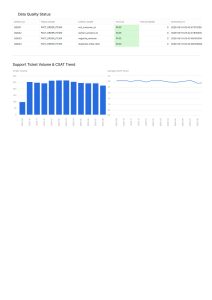
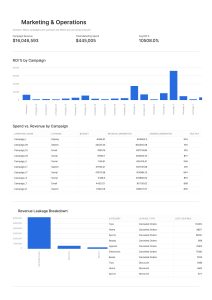
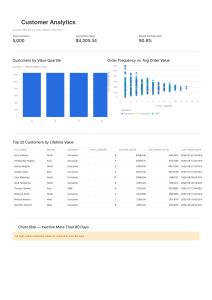
- This meant the three business dashboards were built on already-trusted numbers, not numbers that looked plausible.
SUCCESS AND IMPACT
What Was Achieved
- product, customer, campaign, and financial-leakage data now live in one governed platform instead of scattered spreadsheets and siloed reports
- Product performance made visible
- Customer value quantified
Business Impact
- Business Documents
- Snowflake Staging
- Data Quality Validation
- Reporting & Analytics