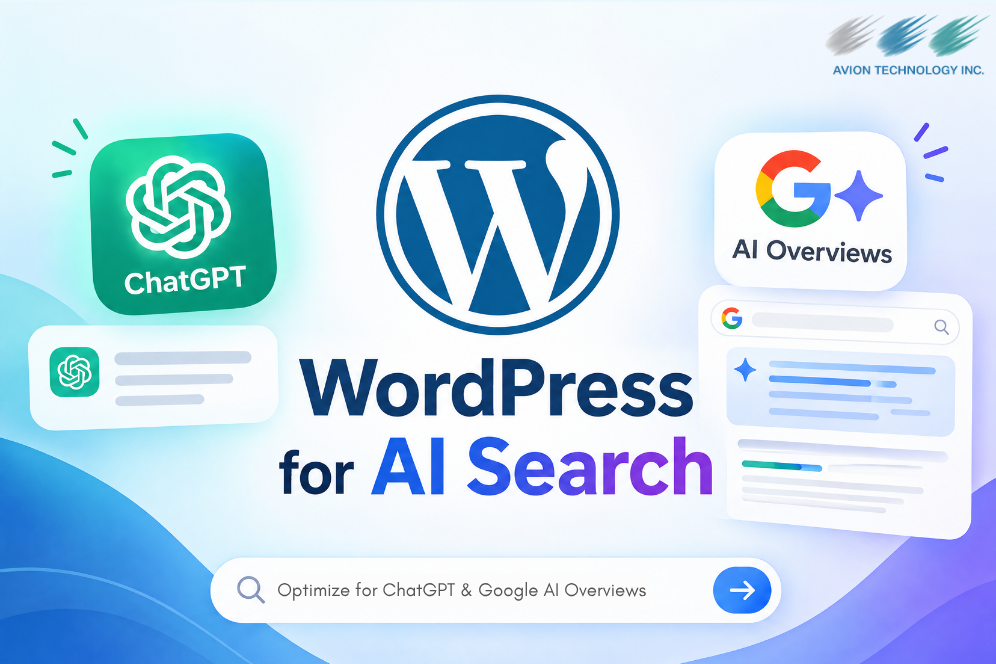
WordPress for AI Search: How to Optimize Websites for ChatGPT and Google AI Overviews
Search is changing. Users are no longer relying only on traditional Google results to find information. They are increasingly asking ChatGPT, Google AI Overviews, Gemini, Perplexity and other AI-powered search systems for direct answers, recommendations, comparisons and solutions.
For businesses using WordPress, this creates a new opportunity: AI search visibility.
However, optimizing a WordPress website for AI search is not about adding more keywords or trying to “hack” ChatGPT. AI systems need to be able to discover your content, understand its meaning, identify trustworthy information and retrieve useful sections when generating answers.
This is where Generative Engine Optimization (GEO) works alongside traditional SEO.
Google’s current guidance also emphasizes that the fundamentals of SEO remain important for visibility in its generative AI features.
What Is AI Search Optimization?
AI search optimization is the process of improving a website so AI-powered search systems can more easily crawl, understand, retrieve and potentially cite its content.
Traditional SEO primarily focuses on rankings, organic traffic and search visibility. AI search introduces another layer: whether your content can become a useful source within an AI-generated answer.
| Traditional SEO | AI Search Optimization |
| Focuses on search rankings | Focuses on retrieval and citations |
| Targets keywords and search queries | Targets topics, entities, questions and meaning |
| Optimizes pages | Optimizes useful content sections |
| Builds organic traffic | Builds visibility in AI-generated answers |
| Uses SEO and technical signals | Combines SEO, content quality, structure, authority and accessibility |
There is no publicly documented universal “AI citation ranking factor.” Instead, current research and industry observations point toward factors such as content quality, topical authority, crawlability, clear structure, internal linking, technical performance and first-hand expertise.
1. Create Content That Directly Answers Questions
One of the most important changes for AI search is answer-first content.
AI systems often retrieve specific sections of a webpage rather than relying on the entire article. This means important answers should not be buried under several paragraphs of introduction.
For example, instead of:
What Is WordPress AI Search Optimization?
Writing five paragraphs before answering the question, start with a concise definition:
WordPress AI search optimization is the process of improving website content, structure, technical performance, and authority so AI-powered search systems can discover, understand and potentially cite the information.
Then expand on the topic.
Use:
- Clear H1, H2, and H3 headings
- Short paragraphs
- Direct definitions
- Question-based headings
- Bullet points
- Numbered processes
- Comparison tables
- Short summaries
- Relevant examples
This structure makes content easier for both users and machines to understand and retrieve.
2. Build Topical Authority Instead of Keyword Stuffing
AI search is increasingly semantic. That means a page does not need to repeat the same keyword dozens of times to demonstrate relevance.
Instead, build topical depth.
For example, a company targeting “WordPress development” could create related content around:
- Custom WordPress development
- WordPress security
- WordPress performance optimization
- WordPress Core Web Vitals
- WordPress API integrations
- Headless WordPress
- WordPress SEO
- WordPress website migration
- Enterprise WordPress development
- WordPress AI optimization
These articles can support a central WordPress development service page.
This creates a connected topic ecosystem that helps search engines and AI systems understand the website’s areas of expertise.
For businesses evaluating a professional WordPress development partner, having technically strong and well-organized service content is equally important. Avion Technology’s WordPress Development Services in the USA can serve as an example of how a dedicated service page can support commercial search intent while related educational content supports informational queries.
3. Make Your WordPress Website Easy to Crawl
Before an AI system can retrieve your content, it needs to be able to access it.
Technical accessibility should therefore be part of your AI search strategy.
Check that:
- Important pages are indexable
- Your XML sitemap is working and updated
- Robots.txt does not accidentally block important content
- Important pages are connected through internal links
- There are no unnecessary orphan pages
- Content is publicly accessible
- Canonical URLs are correctly implemented
- Broken links and excessive 404 pages are fixed
- Important content is not dependent entirely on JavaScript rendering
Your website architecture should make it easy for crawlers to move from your homepage to service pages, categories, articles, case studies and other important content.
Google also recommends ensuring that Google can crawl and index content that you want to appear in its search experiences.
4. Improve WordPress Website Performance
Website performance is not an automatic guarantee of AI citations, but it supports the technical foundation required for search visibility.
A slow WordPress website can create problems with crawling, rendering, accessibility and user experience.
Focus on:
- Core Web Vitals
- Server response time
- Time to First Byte (TTFB)
- Image optimization
- Browser caching
- CSS and JavaScript optimization
- Content delivery networks (CDNs)
- Mobile performance
- Database optimization
- Plugin performance
For example, large images, excessive plugins, poorly optimized themes and heavy JavaScript can slow down WordPress pages.
A technically clean and fast website makes your content easier to access and provides a stronger foundation for both traditional SEO and AI search optimization.
5. Use Structured Data to Explain Your Content
Structured data gives search engines additional context about what a page represents.
For WordPress websites, relevant schema can include:
- Organization
- Article
- Person/Author
- Product
- Service
- Breadcrumb
- Local Business
- Event
- FAQ where appropriate
For example, Article schema can help identify an article’s headline, author, publication information and other properties.
Schema does not guarantee that ChatGPT or Google AI Overviews will cite your page. However, structured data can help machines better understand the entities and relationships represented on a page.
Google states that structured data helps it understand webpage content and can make pages eligible for certain search features.
6. Strengthen Internal Linking
Internal linking is particularly important when building an AI-search-friendly WordPress website.
Do not treat every article as an isolated page. Connect related content using descriptive anchor text.
For example, an article about WordPress AI search cou ld link to:
- WordPress development services
- WordPress SEO
- WordPress performance optimization
- Custom WordPress development
- WordPress website migration
Avoid generic anchors such as “click here.”
Instead, use contextual anchors such as:
WordPress development services
or
WordPress website performance optimization
Internal links help users discover related information while providing additional context about how pages and topics are connected.
7. Add First-Hand Experience and Original Information
Generic AI-generated content is easy to reproduce.
Original information is harder to replace.
Businesses should strengthen their content with evidence of real-world expertise, such as:
- Case studies
- Implementation experiences
- Before-and-after results
- Original research
- Technical testing
- Screenshots
- Benchmarks
- Expert commentary
- Customer examples
- Practical implementation recommendations
For example, instead of publishing another generic article about WordPress performance, a development company could document how it diagnosed a slow website, what technical problems it discovered, what changes were implemented, and how performance changed.
This creates content that provides information beyond what can be easily generated from existing articles.
8. Optimize Images and Other Media
AI search is not limited to text.
Images, videos, documents, and other media can contribute to how a business and its expertise are represented across search ecosystems.
For WordPress, optimize media by using:
- Descriptive image filenames
- Accurate alt text
- Relevant captions
- Proper image dimensions
- Modern image formats where appropriate
- Compressed media
- Supporting text around important images and videos
An image called wordpress-development-services. web provides considerably more contextual information than a generic filename such as IMG1234.webp.
9. Keep Important Content Fresh
AI search environments can change quickly, so outdated information can become a disadvantage.
Review important pages regularly, especially content about:
- Software platforms
- AI tools
- WordPress features
- SEO practices
- Security
- Pricing
- Technology trends
- Product capabilities
When updating content, do more than change the publication date. Improve the actual information.
Add new examples, updated technical recommendations, original insights and relevant internal links.
The goal should be useful freshness, not simply changing a date.
10. What About llms.txt?
llms.txt has received significant attention in the AI search community, but it should not be treated as a replacement for SEO.
Google clarified in June 2026 that llms.txt is not needed for Google Search and does not provide a positive or negative ranking effect. It can still be maintained if other services or systems make use of it.
For WordPress businesses, the priority should therefore remain:
Crawlability → Indexability → Content quality → Topical authority → Internal linking → Structured data → Performance → Original expertise
Do not focus on llms.txt while ignoring basic technical SEO.
SEO + GEO: The WordPress Strategy
The strongest approach is not to choose between SEO and AI search optimization.
Use both.
A practical WordPress AI search strategy looks like this:
- Create content around real customer questions.
- Build technically accessible WordPress pages.
- Answer important questions directly.
- Build topic clusters instead of isolated blog posts.
- Connect related pages with contextual internal links.
- Use relevant structured data.
- Improve Core Web Vitals and mobile performance.
- Demonstrate first-hand expertise and original information.
- Keep important content accurate and updated.
- Monitor how your brand and content appear across AI search platforms.
AI search visibility is also not static. Google notes that its generative AI features use web sources, and the sources surfaced can vary.
WordPress AI Search Optimization Checklist
Final Thoughts
Optimizing WordPress for ChatGPT and Google AI Overviews is not about discovering one secret AI ranking factor.
It is about building a website that is technically accessible, semantically clear, authoritative, useful and easy to understand.
Traditional SEO remains the foundation. GEO and AI search optimization extend that foundation by focusing on how information is retrieved and represented in AI-generated answers.
For businesses investing in WordPress, the opportunity is significant. A well-structured website can support traditional Google rankings while also creating more opportunities for its expertise, services, and content to be discovered across the growing AI search ecosystem.
The best time to prepare a WordPress website for AI search is not after AI becomes the primary way customers discover your business. It is during the process of building, optimizing, and maintaining the website today.
Frequently Asked Questions
1. How do I optimize a WordPress website for AI search?
Optimize your WordPress website by making content easy to crawl, understand, and retrieve. Focus on clear answer-first content, strong topical coverage, descriptive internal links, structured data, fast performance, mobile usability, and original expertise. Traditional SEO fundamentals remain important for visibility in AI-powered search experiences.
2. How can I make my WordPress website more visible in ChatGPT?
There is no guaranteed method to make ChatGPT cite a website. However, businesses can improve their potential AI visibility by publishing authoritative, clearly structured content that directly answers relevant questions, maintaining strong technical SEO, building topical authority, earning credible references and keeping important information accurate and up to date.
3. Does SEO help a WordPress website appear in Google AI Overviews?
Yes. Google states that the same fundamental SEO practices used for Google Search remain relevant to its AI features. A WordPress website should therefore focus on crawlability, indexability, helpful content, internal linking, structured data where appropriate, and overall technical quality rather than using a separate “AI ranking trick.”
4. What is GEO for WordPress websites?
GEO, or Generative Engine Optimization, is the practice of improving website content so AI-powered search systems can better discover, understand, retrieve and potentially reference that information in generated responses. For WordPress, GEO works alongside traditional SEO rather than replacing it.
5. Does WordPress need special plugins to rank in AI search?
No. A WordPress website does not need a specific “AI SEO plugin” to become eligible for AI search visibility. Plugins can help with areas such as SEO, schema, caching and performance, but the fundamentals are technical accessibility, useful content, topical authority, internal linking and a strong website structure.
6. Does llms.txt improve AI search rankings?
There is currently no evidence that adding an llms.txt file directly improves Google Search rankings or guarantees visibility in AI-generated answers. It should not replace essential SEO practices such as crawlability, indexability, content quality, internal linking and technical optimization.