
Case Overview
Led the end-to-end implementation of ServiceNow ITSM and Customer Service Management (CSM) for a multi-department enterprise. The project focused on consolidating legacy systems into a unified platform to standardize service processes, automate workflows, and enhance visibility across IT and customer support operations.
Involvement
- Led end-to-end ServiceNow ITSM & CSM implementation lifecycle.
- Configured workflows, automation rules, and service modules.
- Managed testing, deployment, and stakeholder coordination.
The Brief
To implement a scalable ServiceNow solution that integrates ITSM and CSM capabilities, improves service delivery efficiency, and provides a centralized platform for managing incidents, requests, and customer interactions.
Our Approach
We carefully structured the site to prioritize gentle guidance and informed choice. Key components include:
- Assessed existing systems and defined target ServiceNow architecture.
- Implemented ITSM and CSM modules with standardized workflows.
- Designed service catalog with dynamic forms and automated approvals.
- Configured incident, problem, and change management processes.
- Established CMDB with CI relationships and asset tracking.
- Enabled case management with intelligent routing and omnichannel support.
- Developed reports and dashboards for SLA and performance monitoring.
- Conducted testing, deployment, and user training for seamless adoption
We implemented a unified ServiceNow platform with a focus on automation, standardization, and scalability. Key components include:
Tools Used
- ServiceNow (ITSM & CSM Modules)
- ServiceNow CMDB
- ServiceNow Reporting & Dashboards
The Results
The implementation successfully unified IT and customer service operations on a single ServiceNow platform, significantly improving service delivery efficiency and visibility. Automated workflows reduced manual effort and accelerated resolution times, while SLA tracking ensured accountability and performance improvement. The enhanced customer and employee experience, combined with a scalable architecture, positioned the organization for long-term growth and continuous service optimization.
Related Projects
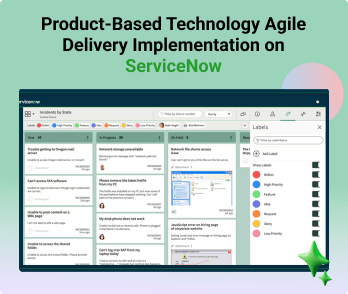
Implemented Agile and Scrum methodologies within ServiceNow to support digital product teams and transformation initiatives. The solution centralized backlog management, streamlined sprint execution, and provided real-time visibility across Agile workstreams using ServiceNow Agile Development capabilities.
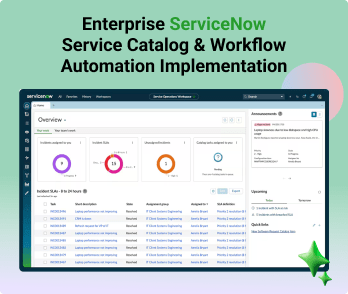
Implemented an enterprise-wide ServiceNow solution to digitalize service request management and automate workflows across multiple departments including IT, HR, Finance, Admin, and Facilities. The project focused on improving process efficiency, routing accuracy, and team collaboration through a scalable Service Catalog and workflow automation framework.
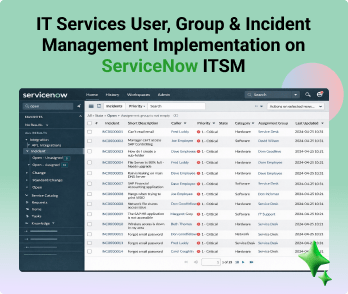
Implemented core ServiceNow ITSM capabilities for a mid-sized enterprise to streamline user administration, automate incident routing, and enhance the Incident Management lifecycle. The solution centralized identity management enforced SLA-driven processes, and improved operational efficiency through automation and modern workspace capabilities.