For decades, the standard for a “high-performing” business was automation. If you could set a rule “When an invoice arrives, send it for approval” you were ahead of the curve. But as we enter 2026, simple automation is no longer enough to maintain a competitive edge. The market is too volatile, and data is too complex for rigid, “if-then” logic.
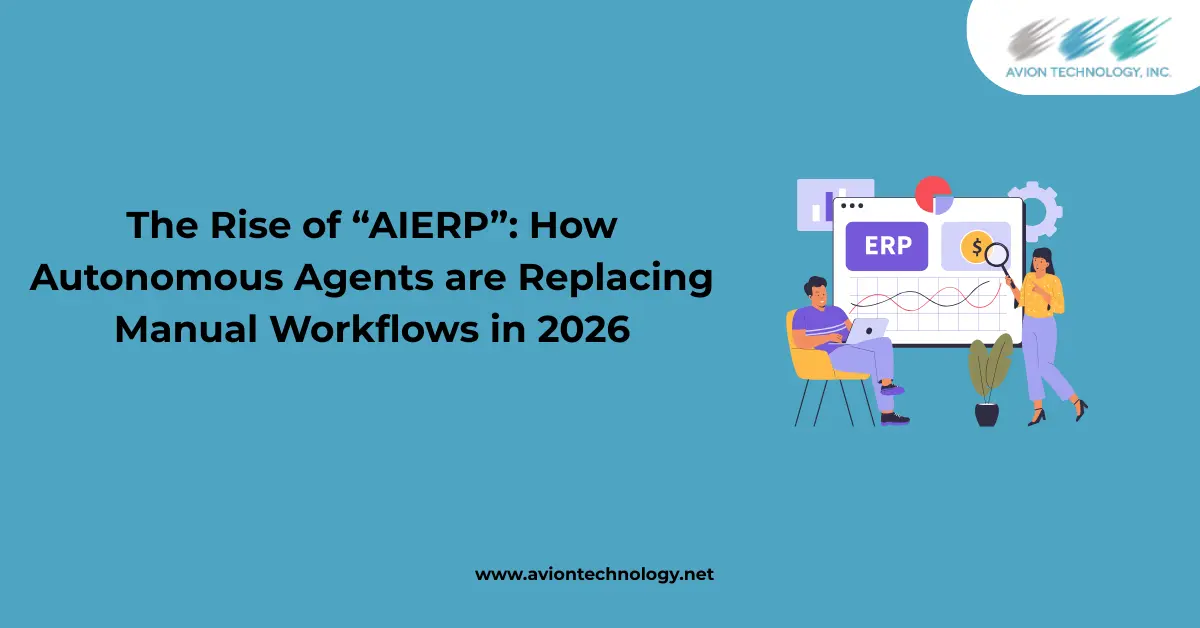
We are now witnessing the most significant shift in enterprise technology since the move to the cloud: the rise of Agentic ERP.
In Microsoft Dynamics 365 Business Central, this means moving from systems that follow instructions to systems that pursue goals. We are moving from a “System of Record” to a “System of Agency.”
What is “Agentic ERP” (And Why Does It Matter)?
Traditional ERP automation is reactive. It requires a human to pre-define every possible scenario. If something unexpected happens a supplier changes their billing format or a customer request is slightly ambiguous the automation breaks, and a human has to step in.
Agentic ERP is proactive. Driven by autonomous agents within the Business Central ecosystem, these digital team members don’t just execute tasks; they “reason.” They understand context. If a delivery is delayed, an autonomous agent doesn’t just flag it; it evaluates the impact on production, checks alternative suppliers, and drafts a revised schedule for the floor manager.
This isn’t just about speed; it’s about operational judgment. This evolution represents the next stage of the smart workflows redesigning operations we have been implementing for our clients.
3 Pillars of Agency in Business Central 2026
Microsoft has embedded three core “agentic” capabilities into the latest 2026 release wave that are fundamentally changing the mid-market landscape:
1. The Autonomous Finance Agent
The “monthly close” used to be a week-long marathon of manual reconciliations. In 2026, the Autonomous Payables Agent handles the heavy lifting. It learns your GL account mapping habits, detects subtle anomalies in vendor behavior, and handles the “Three-Way Match” (PO vs. Receipt vs. Invoice) independently. It only interrupts your Controller when it finds a genuine high-risk discrepancy.
2. Goal-Oriented Supply Chain Orchestration
Managing inventory in a post-2025 world requires more than just “Min/Max” levels. Agentic ERP uses agents that monitor external signals shipping port congestion, weather patterns, and market demand to autonomously adjust procurement. This is the “brain” that prevents stockouts before they happen, a critical tool for manufacturing companies adopting Business Central.
3. The Predictive Sales & Service Agent
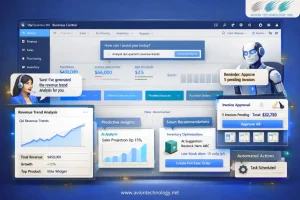
Imagine an agent that lives inside your CRM and ERP simultaneously. When a customer asks for a status update on a complex order, the agent parses the request, checks real-time production status in Business Central, and provides a contextual, accurate response. It can even suggest substitute items if a specific part is delayed, keeping the revenue flowing without human intervention.
Strategic Takeaways for Decision Makers
Transitioning to an agentic model requires a shift in leadership mindset. You are no longer managing “doers”; you are managing “outcomes.”
- Data Integrity is Your New Infrastructure: Agents learn from your data. If your master data is messy, your agents will be confused. Cleaning your data is the single most important step in modernizing your legacy software for the AI era.
- Focus on Exception Management: Your team’s new “KPI” should be how quickly they can resolve the 1% of tasks the AI couldn’t handle, rather than how many invoices they processed manually.
- Scale Without Headcount: Agentic ERP allows you to double your transaction volume without doubling your administrative staff.
How Avion Technology Facilitates the Shift
At Avion Technology, we don’t just install software; we build the logic that makes autonomy possible. Implementing Agentic ERP is a delicate balance of technical configuration and business consulting.
We help you:
- Define Agent Guardrails: We set the limits on what your autonomous agents can do independently and where they must seek human approval.
- Logic Mapping: We ensure the “reasoning” used by the AI aligns with your specific industry regulations and company culture.
- Future-Proofing: We ensure your Business Central environment is structured to ingest the continuous updates Microsoft releases, so you never fall behind the “Agentic curve.”
Ready to stop “doing” and start “leading”? The move to Agentic ERP is not a “someday” project it is the standard for 2026.
Contact Avion Technology today for an AI Readiness Audit and let’s put your ERP to work.
Frequently Asked Questions (FAQ)
Q: Is “Agentic ERP” different from Microsoft Copilot?
A: Yes. Copilot is an assistant that waits for your prompt. Agentic ERP is autonomous; it observes data, identifies a need, and takes action based on a goal you have pre-defined.
Q: Can I trust an AI agent with my financial approvals?
A: You have total control. You can set “Confidence Scores” for example, an agent can approve invoices under $1,000 with a 95% confidence match, but anything higher or less certain requires a human eyes.
Q: How do I know if my business is ready for this?
A: If you are already on the cloud version of Business Central, you have the foundation. The next step is a “Process Map” to identify where manual friction is slowing your growth.
Q: Will this replace my accounting and operations team?
A: It replaces the repetitive tasks they dislike. This allows your team to move into “Analyst” roles where they use the data generated by the ERP to find new ways to grow the business.