In 2024, working with AI often meant refining prompts repeatedly just to generate a usable report. You asked a question, adjusted the wording, clarified the metric, and regenerated the output. It was innovative; but still manual.
In 2026, that experience has changed.
Snowflake has moved beyond simple conversational AI into a model built around Agentic AI Systems. AI that plans, reasons, and executes workflows inside your Cloud Data Warehouse. Instead of answering isolated questions, these systems carry out multi-step objectives and return with structured results, ready for review.
For organizations across the United States, where data maturity, compliance requirements, and operational scale are high, this shift is not theoretical. It is actively reshaping how teams work.
The Shift from Generative to Agentic AI
Generative AI responds. Agentic AI executes.
This evolution is supported by a layered architecture within Snowflake. Snowflake Intelligence uses advanced reasoning engines to break down objectives into actionable steps. Snowflake Cortex Search enables agents to retrieve context from unstructured data such as documents, internal communications, and support logs. Snowflake Cortex Analyst translates business intent into validated SQL aligned with semantic models. And Snowflake Cortex Code allows interaction with data pipelines through a controlled interface.
Together, these components allow AI to move from “What is the answer?” to “What needs to be done?”
The result is not a chatbot upgrade. It is a workflow transformation.
The Reality of the 2026 Update
With every major technological shift comes a practical question: what does this mean for real teams?
The reality is not that jobs disappear overnight. Instead, responsibilities evolve.
In many U.S.-based organizations, data analysts previously spent significant time writing queries, reconciling metrics, and preparing recurring reports. With agentic systems handling structured analysis and context gathering, the analyst’s role increasingly focuses on validating insights, interpreting patterns, and aligning findings with business strategy.
Similarly, operations managers no longer need to manually aggregate system logs and field data before meetings. AI agents can assemble comprehensive situational overviews in advance. The human role becomes directional rather than procedural.
This transition changes how performance is measured. The output shifts from “reports generated” to “decisions guided.”
It is important to recognize that agentic AI introduces collaboration, not replacement. The human remains accountable for approval and oversight. The AI executes within boundaries.
How Jobs Are Changing in the U.S. Workforce
Across the United States, organizations are restructuring responsibilities around AI-augmented workflows.
Three noticeable patterns are emerging:
Analysts are moving closer to strategic planning and scenario modeling. IT Teams are focusing on governance, integration, and AI oversight rather than manual data preparation. Department Heads are becoming workflow directors who assign objectives to digital agents.
The keyboard activity decreases, but decision accountability increases.
This shift requires clarity, policy updates, and reskilling. Agentic AI does not operate effectively in environments where roles are undefined or governance is inconsistent.
Which Skills Employees Need?
Technology adoption without workforce preparation leads to friction. To align with the 2026 Snowflake model, U.S. organizations should approach AI integration as a structured transition.
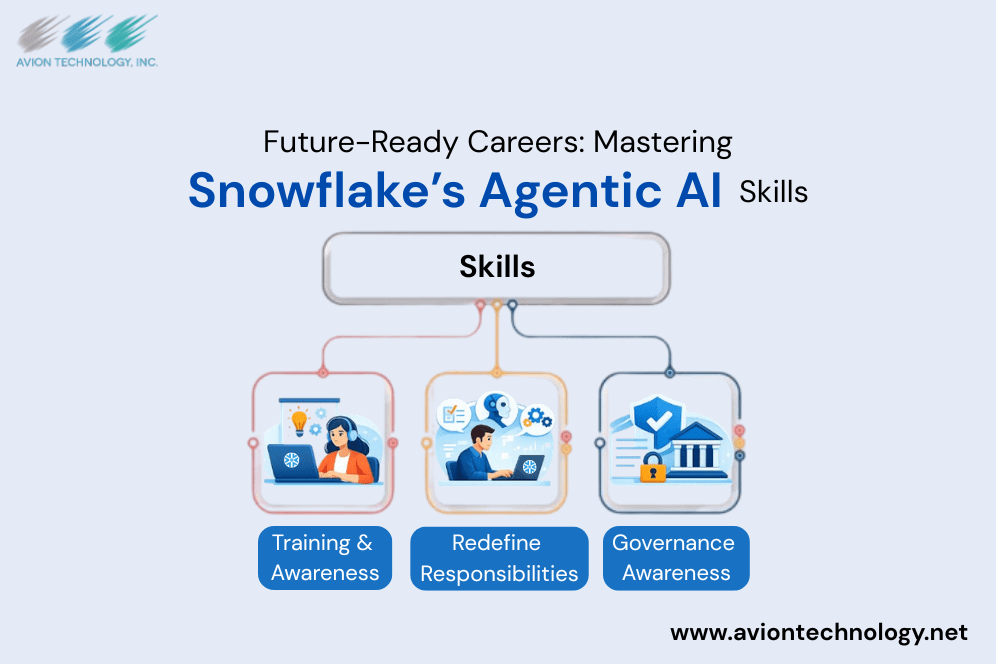
- Training & Awareness: Teams must develop a clear understanding of agentic AI, its capabilities, limitations, and governance requirements; to ensure responsible use within role-based access and human oversight.
- Redefine Responsibilities: Analysts can focus on insight interpretation, data engineers on pipeline resilience and semantic model accuracy, and managers on AI workflow oversight.
- Governance Awareness: With Snowflake Horizon, role-based access control (RBAC) and data policies ensure agents only access authorized information. Employees need to understand these controls and how they apply to AI-driven workflows.
Updating your workforce is not about eliminating positions; it is about elevating them.
How Avion Technology Supports This Transition
As U.S. organizations evaluate the move toward agentic AI, structured implementation becomes critical. For companies operating in competitive U.S. markets; where compliance, scalability, and performance standards are high; structured guidance ensures stability during adoption. This is where Avion Technology plays a strategic role.
Avion Technology helps businesses with the process of planning, structuring, and configuring a Snowflake deployment so it meets an organization’s specific data, workflow, and security needs, providing Snowflake consulting to guide strategy and deployment, conducting architecture reviews to ensure robust, scalable systems, and aligning projects with broader cloud strategy goals for seamless integration. They also offer Snowflake configuration services, implement governance frameworks using Snowflake Horizon, and train internal teams on AI-augmented operational models to ensure smooth adoption and effective collaboration.
Instead of treating agentic AI as a feature toggle, Avion Technology approaches it as a transformation roadmap. From architecture assessment to deployment and employee enablement, the focus remains on controlled integration.
Agentic AI should not be rushed. It should be designed.
Agentic AI Revolution in Healthcare
By 2026, U.S. healthcare organizations will use agentic AI to support both clinical and administrative roles. From patient scheduling to clinical research analysis, AI handles repetitive, data-heavy tasks with accuracy. Decision-making shifts from reviewing static dashboards to guiding AI agents, letting professionals focus on patient care and strategic priorities.
Ready to Lead in 2026?
2026 is not just another AI milestone; it’s the year digital systems begin taking on structured responsibilities. The question is no longer whether AI can generate answers, but whether your organization is ready to assign it real accountability. If you’re exploring how agentic AI fits into your Snowflake strategy…
Connect with the experts at Avion Technology and start shaping your next move with clarity and confidence.