



Manufacturing ERP Rollout Mid Size Electronics Company
Project Type
Manufacturing ERP Mid Size Electronics
Domain
Microsoft Dynamics 365 Business Central
 OVERVIEW
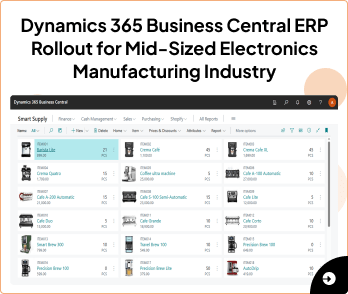
Led the end-to-end implementation of Microsoft Dynamics 365 Business Central for a mid-sized electronics manufacturing company.
The project focused on replacing fragmented legacy systems with a unified ERP platform to streamline operations, improve visibility, and support scalable growth.
 Problem Statement
Involvement
- Led end-to-end ERP implementation using Microsoft Dynamics 365 Business Central, from requirements to go-live.
- Collaborated with cross-functional teams to design, configure, and optimize business processes and modules.
- Managed data migration, reporting (Power BI), UAT, and post-go-live support.
The Brief
To implement a unified ERP solution using Microsoft Dynamics 365 Business Central for a mid-sized electronics manufacturer, replacing disconnected legacy systems, improving operational efficiency, and enabling real-time visibility across finance, inventory, procurement, and production.
APPROACH
Our Approach
We carefully structured the site to prioritize gentle guidance and informed choice. Key components include:
We followed a structured and business-focused ERP implementation strategy to ensure seamless system adoption and operational efficiency. Key components include:
Assessement
- Analyzed existing legacy systems to identify process gaps, inefficiencies, and integration challenges.
- Re-engineered and standardized workflows across finance, inventory, procurement, and production.
Design
- Configured Microsoft Dynamics 365 Business Central modules aligned with business requirements.
- Implemented finance automation, real-time inventory tracking, MRP, and demand forecasting for better planning.
- Established vendor management processes with automated purchasing and performance tracking.
Tools & Technologies
- Microsoft Dynamics 365 Business Central
- Microsoft Dynamics ERP
- Power BI
- Microsoft Excel
The Result
The implementation successfully unified multiple legacy systems into a single, integrated ERP platform, significantly improving operational efficiency through automation and standardized workflows. Financial reporting became more accurate with faster month-end closures, while enhanced inventory visibility reduced discrepancies and carrying costs. Demand forecasting and production planning were optimized, and real-time Power BI insights enabled better, data-driven decision-making across the organization.
