



Healthcare IT Service Management Platform
 CASE STUDY DETAILS
Windy City Health
Project Type
Enterprise Platform Implementation
Challenge
Fragmented Healthcare IT Operations
Domain
Healthcare / IT Operations
Impact
15-Minute Critical Incident Response
OVERVIEW
Windy City Health is a 50-hospital healthcare network serving the Chicago metropolitan area with over 15,000 employees and 200+ IT staff across four support teams. The organization needed a centralized IT Service Management platform to replace fragmented, manual processes that were directly impacting patient care and clinical system uptime.
We led the end-to-end implementation — from organizational design and data architecture through module configuration, workflow automation, and executive reporting — delivering a fully operational ITSM solution on ServiceNow that now serves as the single system of record for all IT operations across the network.
 Problem Statement
The client lacked a centralized IT service management system for handling healthcare technology operations, resulting in challenges such as:
The challenge was to develop a centralized and scalable healthcare IT service management solution that could standardize ticket handling, enforce SLAs, automate escalation, support incident and problem management, control changes, centralize knowledge, and provide leadership with real-time operational visibility.
- IT requests received through disconnected channels like email, phone calls, and walk-ups
- No standardized ticket tracking process
- Critical medical equipment issues handled reactively
- EHR outages and patient monitor failures without structured escalation
- No SLA enforcement or defined escalation paths
- Recurring incidents not traced to root causes
- Uncontrolled changes causing unexpected system outages
- Knowledge scattered across disconnected teams
- Limited visibility into IT workload and performance
- No centralized leadership reporting on resolution time
Solutions
To address these challenges, we designed and implemented a comprehensive healthcare IT service management ecosystem:
1. Organizational Foundation & CMDB
- Built the complete organizational hierarchy, including company structure, 4 hospital locations, and 6 departments.
- Configured 8 IT staff users across 4 functional support groups:
- Help Desk
- Clinical Systems
- Network Team
- Biomedical Engineering
- Populated the CMDB with critical medical devices such as CT scanners, MRI machines, and patient monitors.
- Added clinical servers and application assets to the CMDB.
- Created dependency mapping to support intelligent ticket routing and impact analysis.
3. Problem Management for Root Cause Elimination
- Created problem records for recurring clinical IT failures.
- Covered CT scanner error patterns, EHR peak-hour performance issues, and Emergency Department WiFi dead zones.
- Linked related incidents to corresponding problem records.
- Documented root cause analysis.
- Supported permanent fixes instead of repeated break-fix cycles.
5. Knowledge Management & Self-Service Catalog
- Created a knowledge base containing clinical IT support articles.
- Included EHR login troubleshooting, CT scanner error code references, and password reset guides.
- Enabled self-service resolution for common IT issues.
- Built 10 healthcare-specific service catalog items with 50 form variables.
- Added HIPAA compliance warnings for EHR access requests.
- Added safety alerts for medical device-related requests.
- Included policy references for VPN access requests.
7. Flow Designer Automation
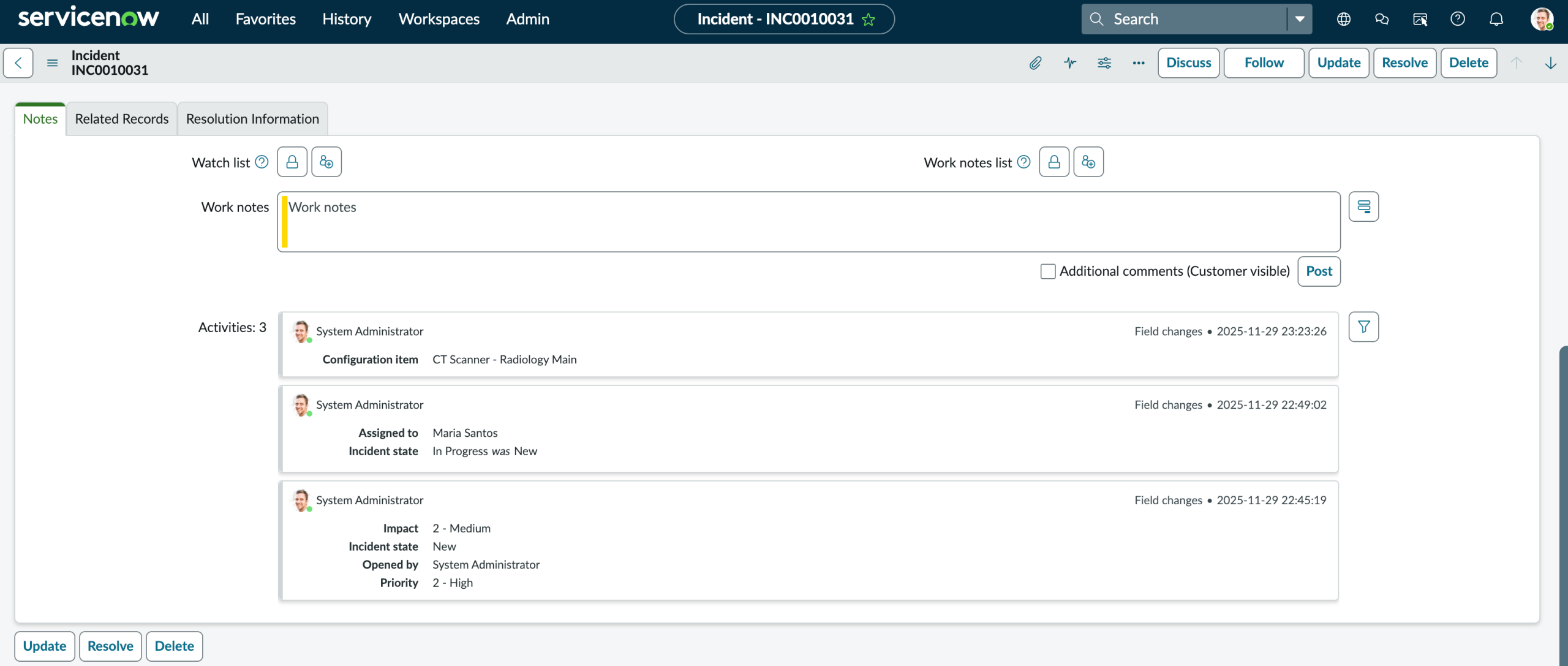
- Implemented a 15-minute acknowledgement timer with manager notification for P1 incidents.
- Added category-based intelligent ticket assignment.
- Implemented CAB approval tracking for changes.
- Automated escalation and notifications for SLA breaches.
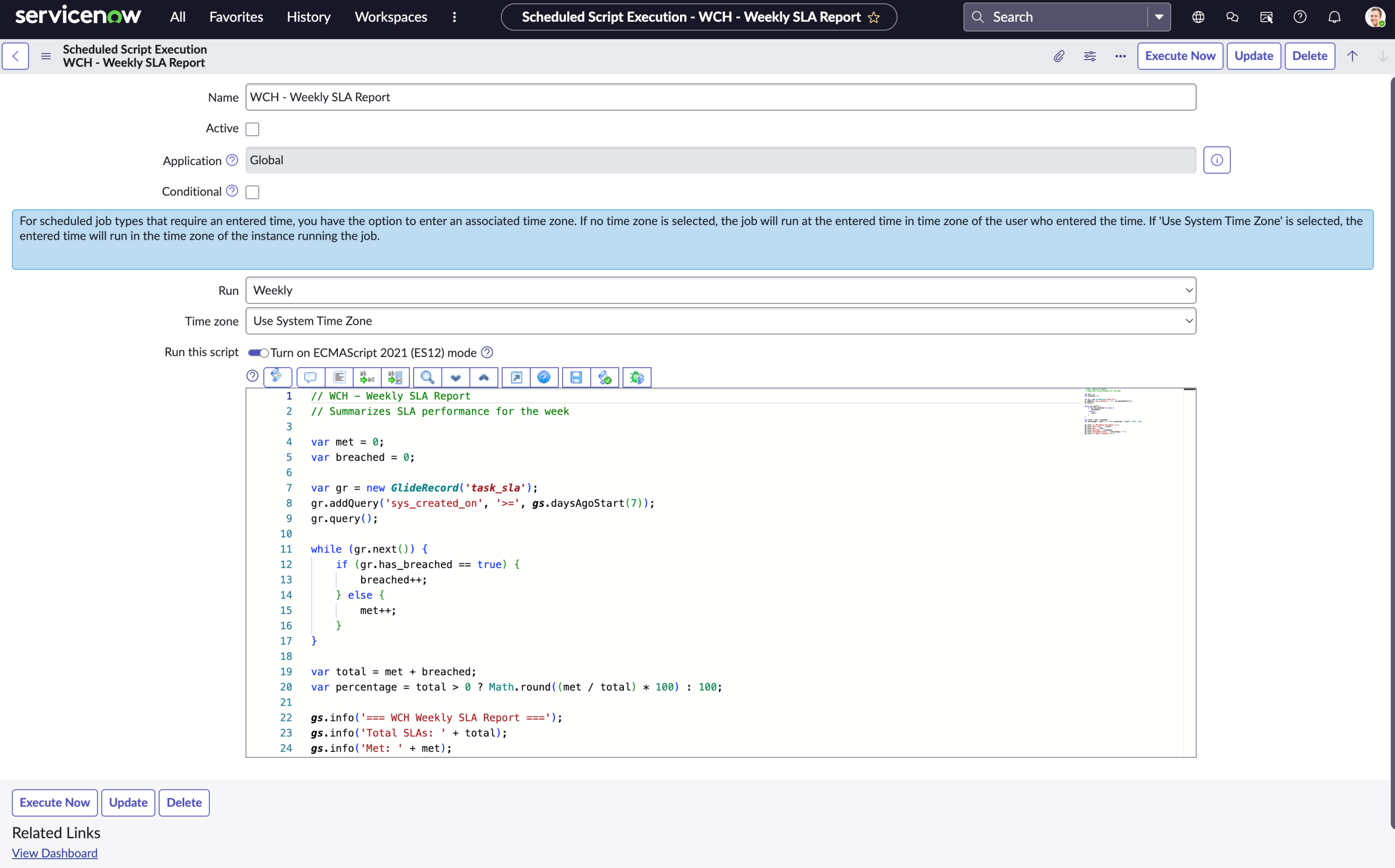
- Added scheduled jobs for daily stale incident reports.
- Added weekly SLA performance summaries.
2. Incident Management with Healthcare Priority Matrix
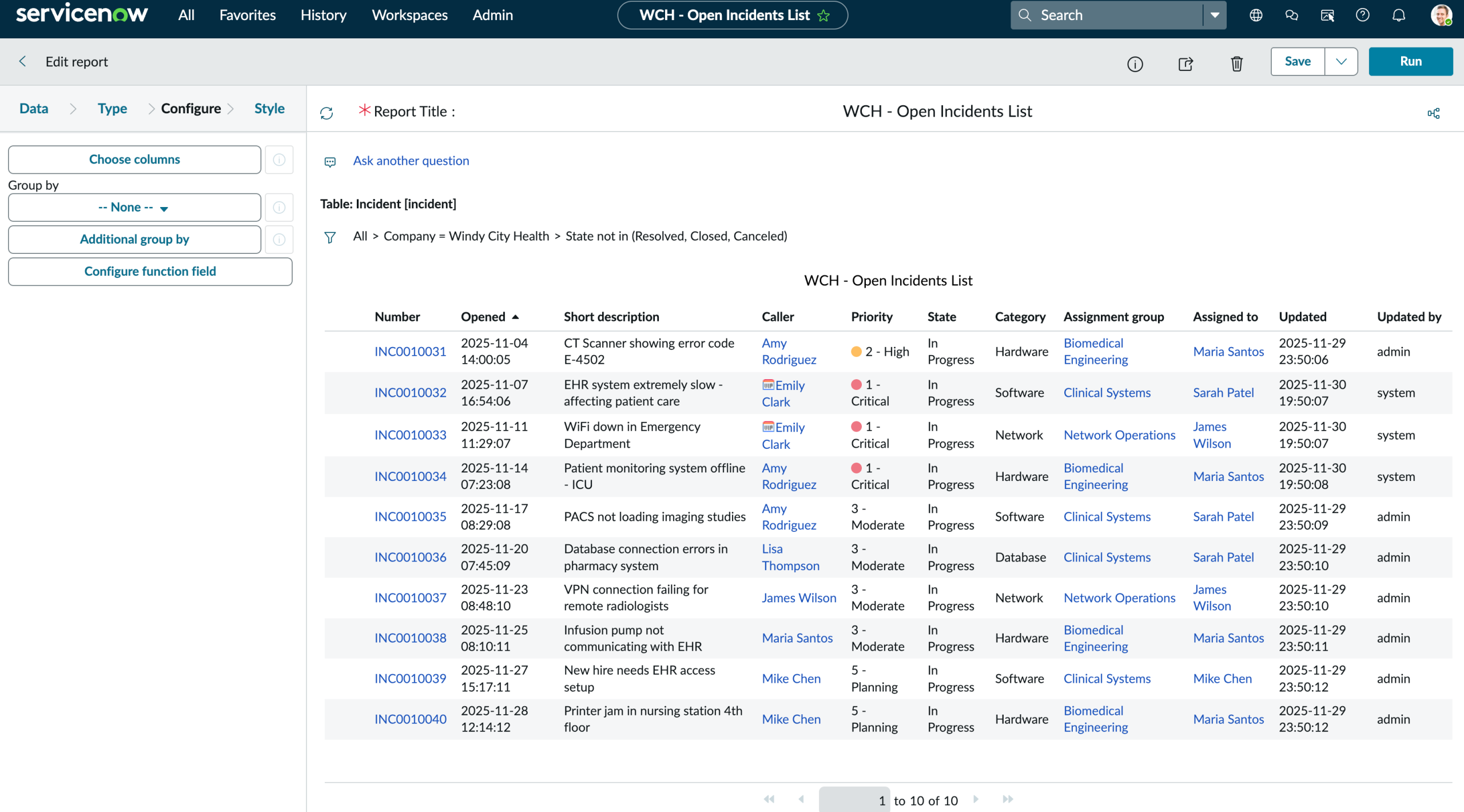
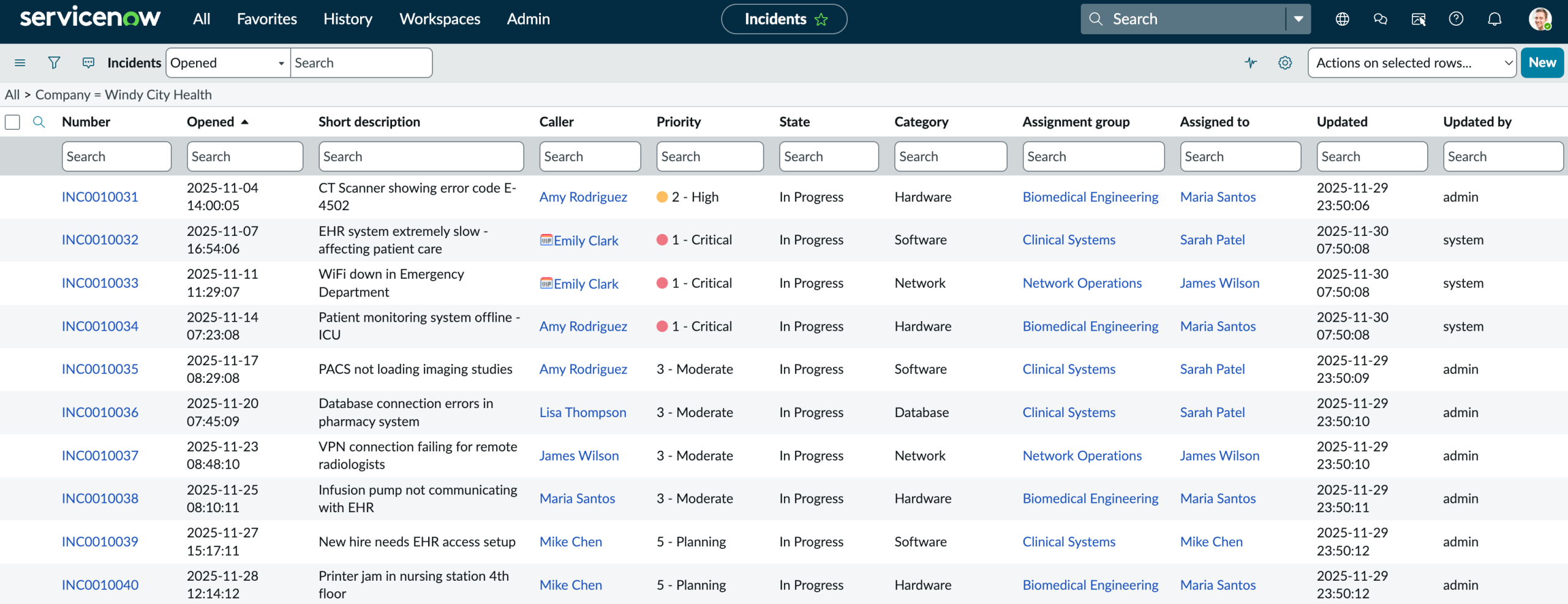
- Configured 10 healthcare-specific incident scenarios.
- Covered priorities from P1-Critical to P4-Low.
- Included critical scenarios such as CT scanner failures and EHR outages.
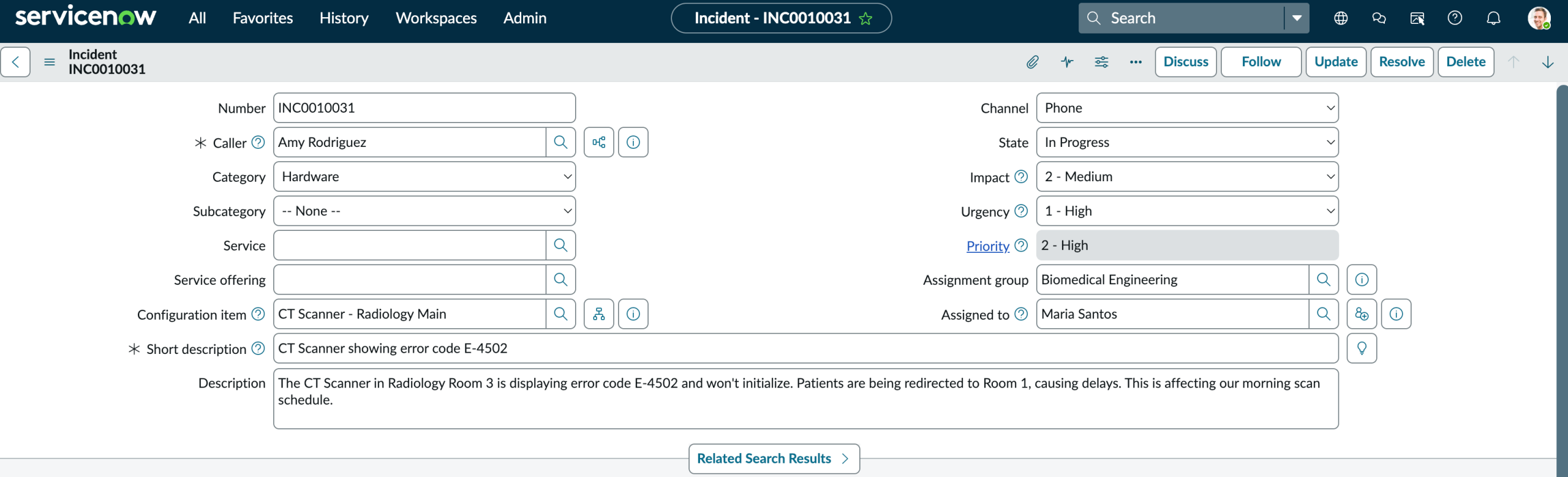
- Implemented automatic priority calculation using Impact × Urgency.
- Linked incidents to affected configuration items to quickly identify clinical impact.
4. Change Management with CAB Approval Workflow
- Implemented a complete change management lifecycle.
- Configured Normal Changes requiring Change Advisory Board (CAB) approval.
- Supported examples such as CT firmware upgrades and EHR memory expansion.
- Configured Emergency Changes with expedited review for critical issues.
- Implemented Standard Changes using pre-approved templates.
- Added risk assessment, implementation scheduling, and post-implementation review processes.
- Designed the workflow to prevent unplanned outages.
6. SLA Framework with Medical Device Escalation
- Designed 8 healthcare-specific Service Level Agreements.
- Configured 15-minute response / 2-hour resolution for critical medical device issues.
- Configured 15-minute response / 4-hour resolution for critical EHR and network issues.
- Scaled SLA targets down to 8-hour response / 72-hour resolution for low-priority issues.
- Implemented an SLA breach handler flow.
- Automatically escalated overdue tickets.
8. Executive Reporting & Dashboards
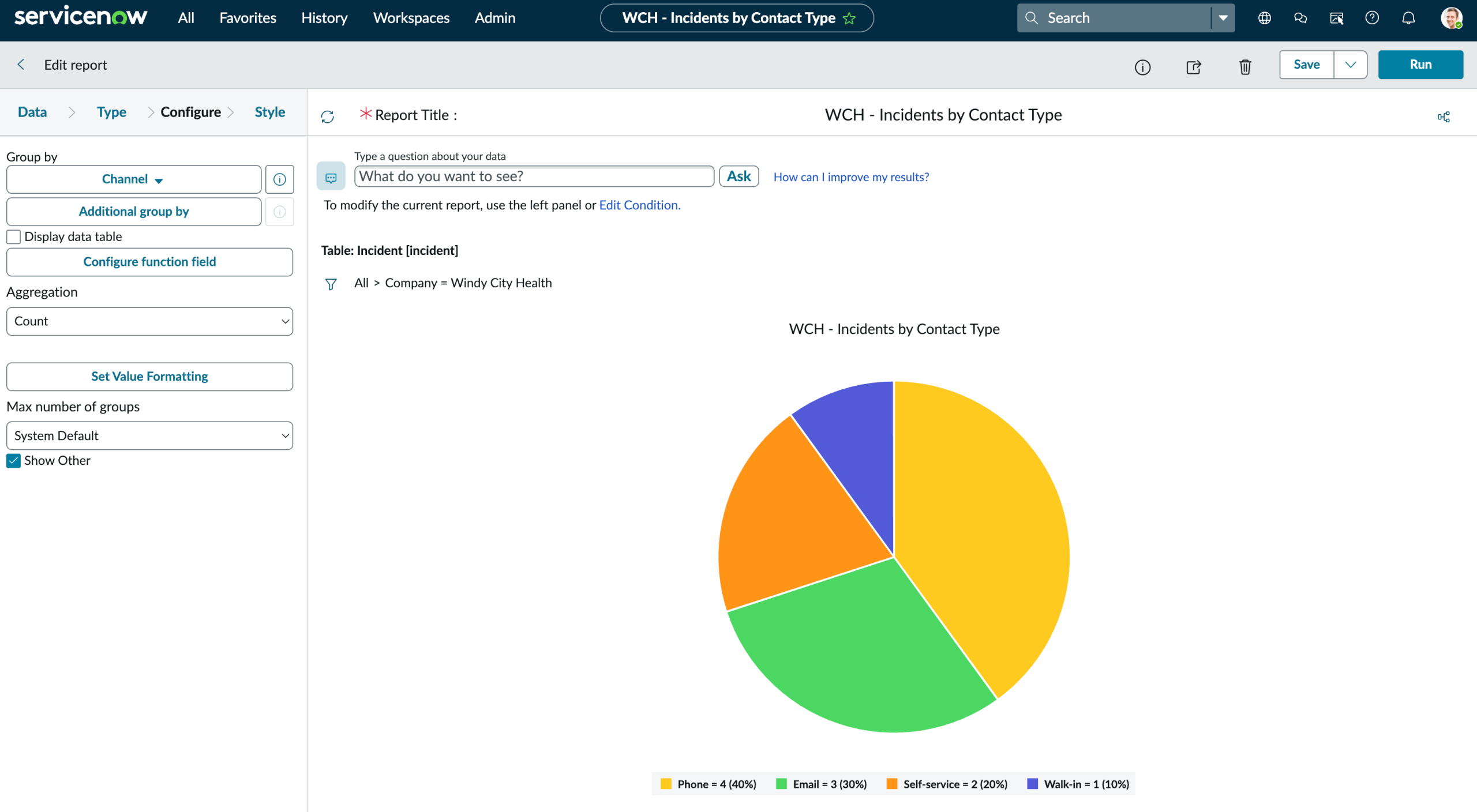
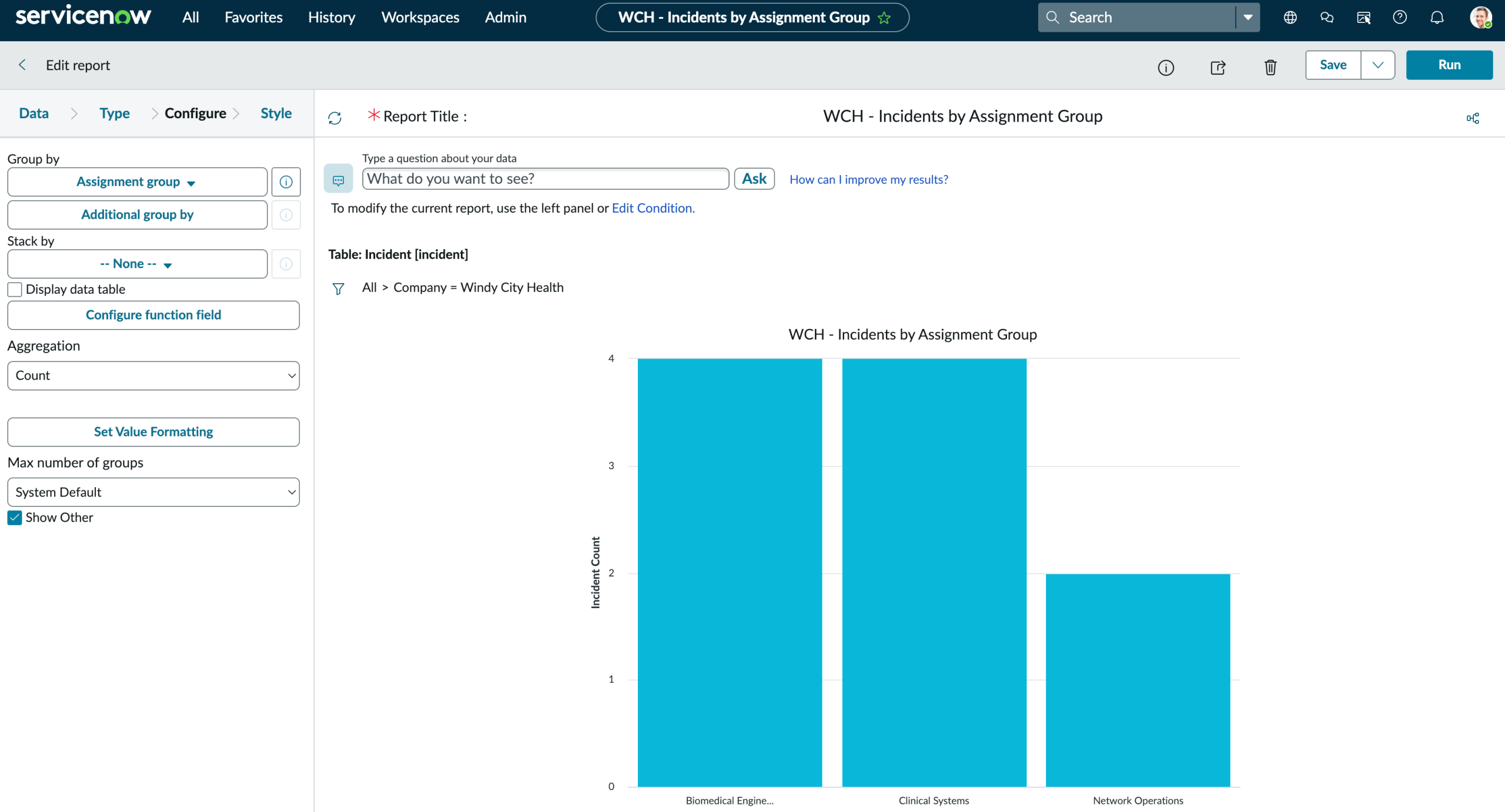
- Used visualizations including pie charts, bar charts, and donut charts.
- Created an executive dashboard combining key operational metrics.
- Provided leadership with at-a-glance visibility into IT operational health.
APPROACH
Our Approach
Discovery & Assessment
- Mapped existing IT operations across all 50 hospital locations and identified key operational pain points.
- Assessed issues including 4-hour average response times for medical device failures, 12+ recurring incidents without root-cause tracking, and limited workload visibility.
- Documented current-state IT processes and defined target-state workflows with measurable KPIs.
Architecture & Data Design
- Designed the organizational data model covering locations, departments, user roles, group memberships, and CMDB asset categories.
- Defined category-to-assignment-group routing and automated priority calculation logic.
- Designed healthcare-focused SLA tiers, prioritizing patient safety equipment for the fastest response times.
Platform Configuration
- Configured the ITSM foundation and implemented Incident, Problem, Change, Knowledge Management, and Service Catalog modules.
- Configured assignment rules, business rules, UI policies, client scripts, and notification rules to support standardized operations.
- Implemented Flow Designer workflows and scheduled jobs, validating each module against healthcare-specific scenarios.
Automation & Integration
- Implemented server-side business rules for automatic priority calculation, category enforcement, and P1 manager notifications.
- Configured UI policies and client scripts to enforce required fields, configuration items, and real-time data validation.
- Built Flow Designer workflows for incident escalation, ticket routing, change approvals, and SLA breach handling.
Reporting & Handover
- Built executive dashboards and operational reports to provide visibility into incidents, workload, SLAs, and IT performance.
- Documented platform configurations with step-by-step verification procedures.
- Delivered an implementation guide covering 19 configuration steps across 6 phases, including navigation paths and screenshot references.
Tools & Technologies
Salesforce Development & Integration:
Platform: ServiceNow (Zurich 2025)
Modules: ITSM (Incident, Problem, Change, CMDB, Knowledge, Service Catalog)
Automation: Flow Designer, Business Rules, Client Scripts, UI Policies, Assignment Rules
Notifications: Email Notifications, Scheduled Jobs
Reporting: ServiceNow Reporting, Performance Analytics Dashboards
Integration: REST API, GlideRecord Server-Side Scripting
Portal: Service Portal (self-service catalog intake)
success and impact
What the Client Achieved
- Centralized operations — All IT requests tracked in a single system across 50 hospitals
- Automated routing — Tickets auto-assigned to correct support group by category, eliminating manual triage
- SLA enforcement — Response and resolution times enforced with automatic escalation on breach
- Root cause visibility — Problem Management links recurring incidents to root causes, driving permanent fixes
- Controlled change process — CAB approval workflow prevents unplanned outages from uncontrolled changes
- Self-service enablement — Knowledge base and service catalog reduce L1 contact volume
- Executive dashboards — Real-time visibility into incident volume, priority distribution, team workload, and SLA compliance
Business Impact
- Incident routing time reduced from hours to seconds via auto-assignment
- Medical device critical response enforced at 15 minutes (previously 4+ hours average)
- 100% of changes now go through documented approval process
- Knowledge base enables self-service for common issues (password resets, EHR troubleshooting)
- 6 operational reports provide leadership visibility that previously did not exist
- Complete audit trail for all IT operations supporting healthcare compliance requirements
Services we offered

ServiceNow ITSM Implementation
IT Process Design & Optimization
Workflow Automation (Flow Designer)
CMDB Design & Population
Service Catalog Development
SLA Framework Design
Phone
+1 (224) 209-9860Address
1600 McConnor Parkway,
Suite 125, Schaumburg, IL 60173

Schedule a free consultation
Phone
+1 (224) 209-9860Address
1600 McConnor Parkway,
Suite 125, Schaumburg, IL 60173