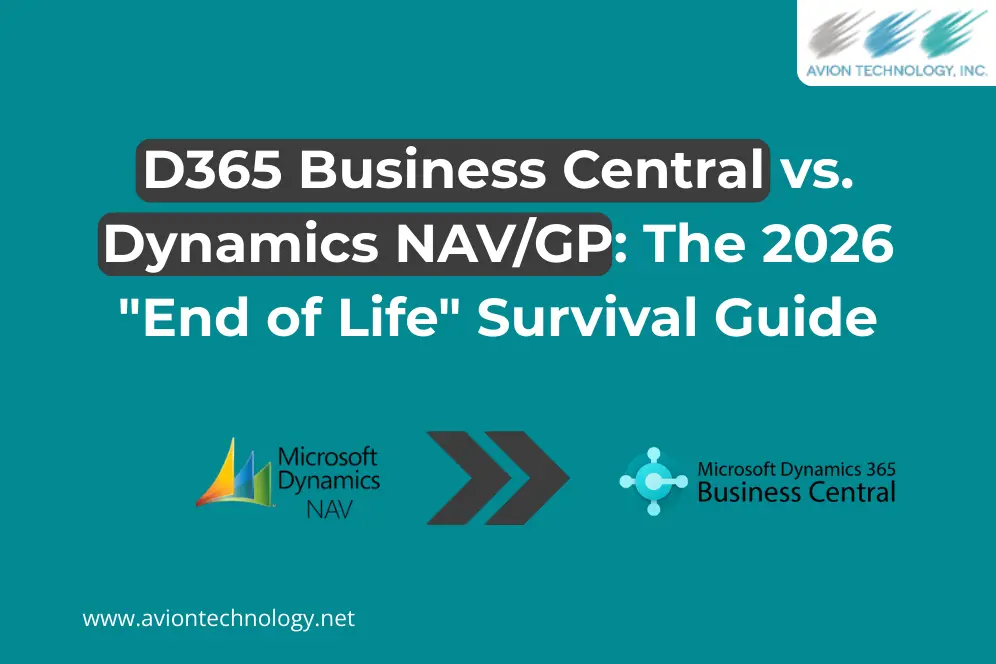
We’ve all heard the phrase, “If it ain’t broke, don’t fix it.” For a long time, that was the unofficial motto for businesses running Dynamics NAV and GP (Great Plains). These systems were the bedrock of Chicago’s manufacturing and distribution sectors for decades. They worked. They were familiar. They felt “free” because the licenses were already paid for.
But as we settle into 2026, the “if it ain’t broke” mindset is becoming dangerous.
The truth? Your legacy ERP is broken—not because it won’t turn on, but because it’s keeping your business stuck in a manual, 2015 way of operating while your competitors are moving at the speed of AI. If you are still relying on VPNs, manual data entry, and “Excel workarounds,” you aren’t just running an old system; you are paying a massive “hidden tax” on your growth.
The “Silent Killer” of Legacy ERP: The Integration Gap
The biggest issue we see at Avion Technology isn’t that NAV or GP fails to calculate numbers. It’s that these systems were built for an era that no longer exists.
In 2026, your ERP needs to talk to everything—your Shopify store, your 3PL providers, your CRM, and your banking apps. Legacy systems were built as “islands.” To get data out of them, you usually need a developer, a custom script, and a lot of luck. This friction is exactly why many firms are realizing that modernizing legacy software is the only way to stay competitive.
While your team is busy manually re-keying data from one system to another, companies on Business Central are using native integrations to automate the entire flow.
What 2026 “Agentic ERP” Means for Your Bottom Line
If you haven’t been following the 2026 Release Wave 1 updates for Business Central, the game has changed. We are no longer talking about simple “automation.” We are talking about Autonomous AI Agents.
In a legacy GP environment, if a customer emails to change an order, a human has to read that email, find the record, check the warehouse stock, and manually update the entry. In Business Central, an AI Sales Agent can do that entire process in seconds, leaving your staff to focus on actual customer service instead of data entry.
This shift toward the rise of AIERP is the single biggest reason to migrate. You simply cannot run these agents on a system that lives on a server in your broom closet. They require the power of the Microsoft Cloud.
3 Reasons You Can’t Afford to Wait Another Year
1. The Talent Crisis
Finding a developer who understands the deep “spaghetti code” of a 15-year-old NAV instance is getting harder and more expensive every day. The new generation of accountants and operations managers expects modern tools. If you force a new hire to use a clunky, Windows-95-style interface, they likely won’t stay long.
2. The Compliance Trap
From new IRS electronic filing mandates to the complex sustainability reporting now required for U.S. supply chains, legacy systems are struggling to keep up. Business Central updates these regulatory features automatically. In GP or NAV? You’re likely looking at a manual workaround or an expensive custom patch.
3. Security (The VPN Headache)
Ransomware is more sophisticated in 2026 than ever before. On-premise servers are the primary target for these attacks. Business Central benefits from Microsoft’s multi-billion dollar security infrastructure, meaning you can sleep better at night knowing your financial data isn’t one phishing email away from being locked forever.
The Migration Myth: “It’s Too Much Work”
The most common pushback we hear is: “A migration will paralyze my business for months.” Ten years ago, that might have been true. But the migration path from NAV to Business Central is now a well-oiled machine. Because BC is the “cloud version” of NAV, the database structures are siblings. With the right partner, you can migrate your data, train your team, and go live without the “business paralysis” you fear.
The goal isn’t just to move your data; it’s to redesign your daily operations for the modern world. We call this moving from legacy to leading edge.
Conclusion: Don’t Let Your ERP Be Your Ceiling
Your ERP should be the engine that drives your growth, not the ceiling that limits it. If you find yourself saying, “We can’t do that because our system won’t allow it,” you have already outgrown your legacy software.
As we move through 2026, the businesses that thrive will be the ones that offload the “busy work” to AI and focus their human energy on strategy and relationships. Dynamics NAV and GP served you well for years, but it’s time to give them the retirement they’ve earned.
Is your Chicago business ready for the cloud?
At Avion Technology, we don’t just sell software; we build the bridge from where you are to where you need to be. Let’s look at your current setup and show you exactly what a 2026-ready business looks like.
Book your 15-minute Migration Discovery Session with Avion Technology today.