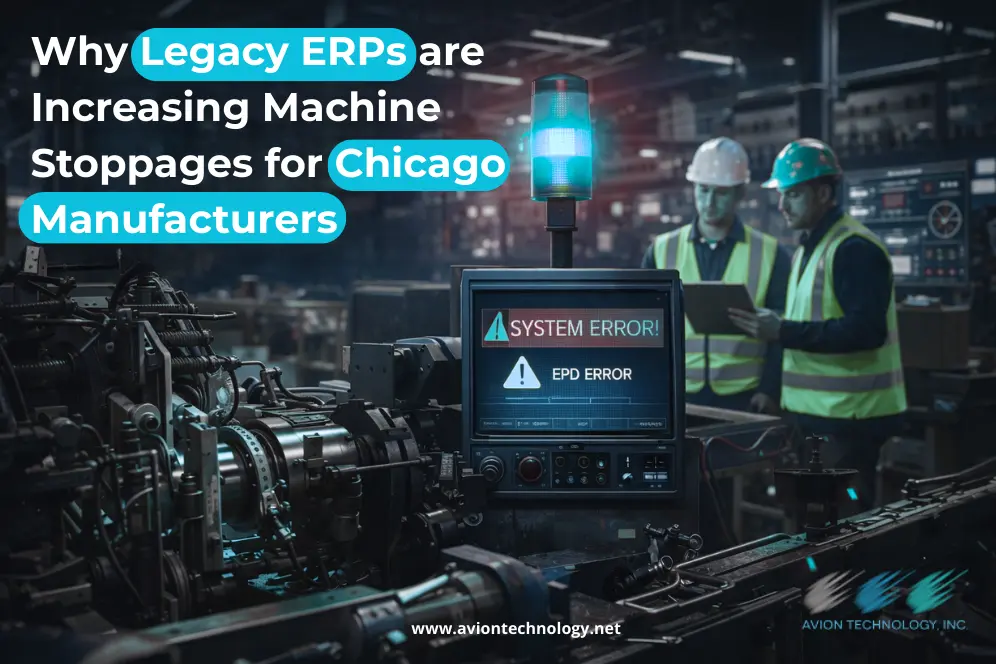
For many plant managers in Chicago’s industrial corridors, from the specialized fabrication shops in Elk Grove Village to the high-volume production lines on the South Side, there is a sound more terrifying than a fire alarm: silence. When a machine stops unexpectedly, the financial bleeding begins instantly. In 2026, the primary culprit behind these “Friday afternoon breakdowns” isn’t always a worn-out belt or a blown fuse; increasingly, it is the outdated Legacy ERP system running in the back office.
While it might seem like the software in the accounting office has nothing to do with the CNC machine on the floor, the reality of modern manufacturing proves otherwise. As we navigate 2026, the gap between “office tech” and “floor tech” has vanished. Companies relying on older systems are finding that their technology is no longer just slow, it’s actually causing physical stoppages.
The Invisible Wall: Disconnected Data and Deadlines
The most common reason for a machine stoppage isn’t a mechanical failure, but a lack of resources. Legacy ERPs often operate as “static” databases. They tell you what you had yesterday, not what you have right now. When the floor team relies on paper-based reports or delayed data, they eventually run into the “Ghost Inventory” trap.
A machine stops because a specific specialized fastener or raw material is missing, even though the ERP says it’s in stock. This happens because old systems don’t update in real-time. By the time the office realizes they are out of stock, the production line has already sat idle for two hours. This is why manufacturing companies in Chicago are moving toward cloud-native solutions that provide a single, live version of the truth.
1. The Failure of “Reactive” Maintenance
Legacy systems like Dynamics NAV or older versions of GP were built for a reactive world. You wait for something to break, you create a work order, and you fix it. In 2026, that model is a recipe for bankruptcy. Modern production demands predictive maintenance.
Microsoft Dynamics 365 Business Central now utilizes IoT (Internet of Things) sensors to “listen” to your machines. If a motor starts drawing more current than usual or a spindle begins to vibrate at a specific frequency, the system knows a failure is imminent. An AI agent can automatically schedule maintenance during a planned shift change before the machine breaks. If you are still operating on a system that doesn’t support these autonomous agents, you are essentially gambling with your uptime every single day.
2. Scheduling Bottlenecks and Labor Friction
Chicago is currently facing a significant skilled labor shortage. When your ERP is difficult to use, your veteran floor managers spend more time fighting with software than they do optimizing production. Legacy systems often require “workarounds” manual spreadsheets kept on a desktop to manage the real shop floor schedule.
When these spreadsheets fall out of sync with the ERP, the schedule collapses. You might have two different jobs scheduled for the same machine simultaneously, or worse, a machine sitting open because the “manual” schedule didn’t account for a shift change. This friction leads to idle machines and frustrated employees. Modernizing to a “Smart Workflow” environment ensures the schedule is dynamic, adjusting automatically when an order is delayed or an employee calls in sick.
3. The Cost of Technical Debt
Many Chicago manufacturers hesitate to upgrade because they fear the “downtime” of an implementation. However, the cost of waiting is now far higher than the cost of action. Older systems lack the security protocols to defend against 2026 cyber-threats, and they cannot integrate with modern CAD/CAM software or robotic arms.
If your ERP cannot talk to your machines, your machines will eventually stop talking to you. This “technical debt” manifests as physical downtime. Every hour spent manually translating data from the office to the shop floor is an hour that a machine could have been running at 100% capacity. For firms still on legacy platforms, the NAV & GP End of Life is a final warning that the bridge to modern efficiency is closing.
Conclusion: Bridging the Gap for Chicago’s Future
The goal of a modern Chicago manufacturer is “Continuous Production.” You cannot achieve that with a disconnected, legacy brain. By moving to an integrated, AI-driven platform like Business Central 2026, you turn your ERP from a record-keeper into a maintenance-saver.
When your software can predict a breakdown, automate your inventory replenishment, and sync your floor schedule in real-time, machine stoppages become a rarity rather than a daily crisis. Modernization isn’t just about new software; it’s about keeping your machines humming and your “Made in Chicago” labels moving out the door.
Is Your Legacy ERP Killing Your Uptime?
Don’t wait for the next major breakdown to realize your software is obsolete. Avion Technology specializes in helping Chicago manufacturers move from aging legacy systems to high-performance Business Central environments.
Contact our Chicago team for a Production-Floor Efficiency Audit Today